By alloying lithium metal, we can change its properties, and therefore change its electrochemical performance. Understanding this, to enable rationally designed lithium alloys for high-performance solid state batteries, has been my main research focus for the past 5 years. Other interests include microstructure-dependent mechanics.
Lithium alloys for solid state batteries.
- High Diffusivity Lithium Intermetallic in Two-Phase Alloy Negative Electrode for Solid-State Batteries – ResearchSquare / 2025
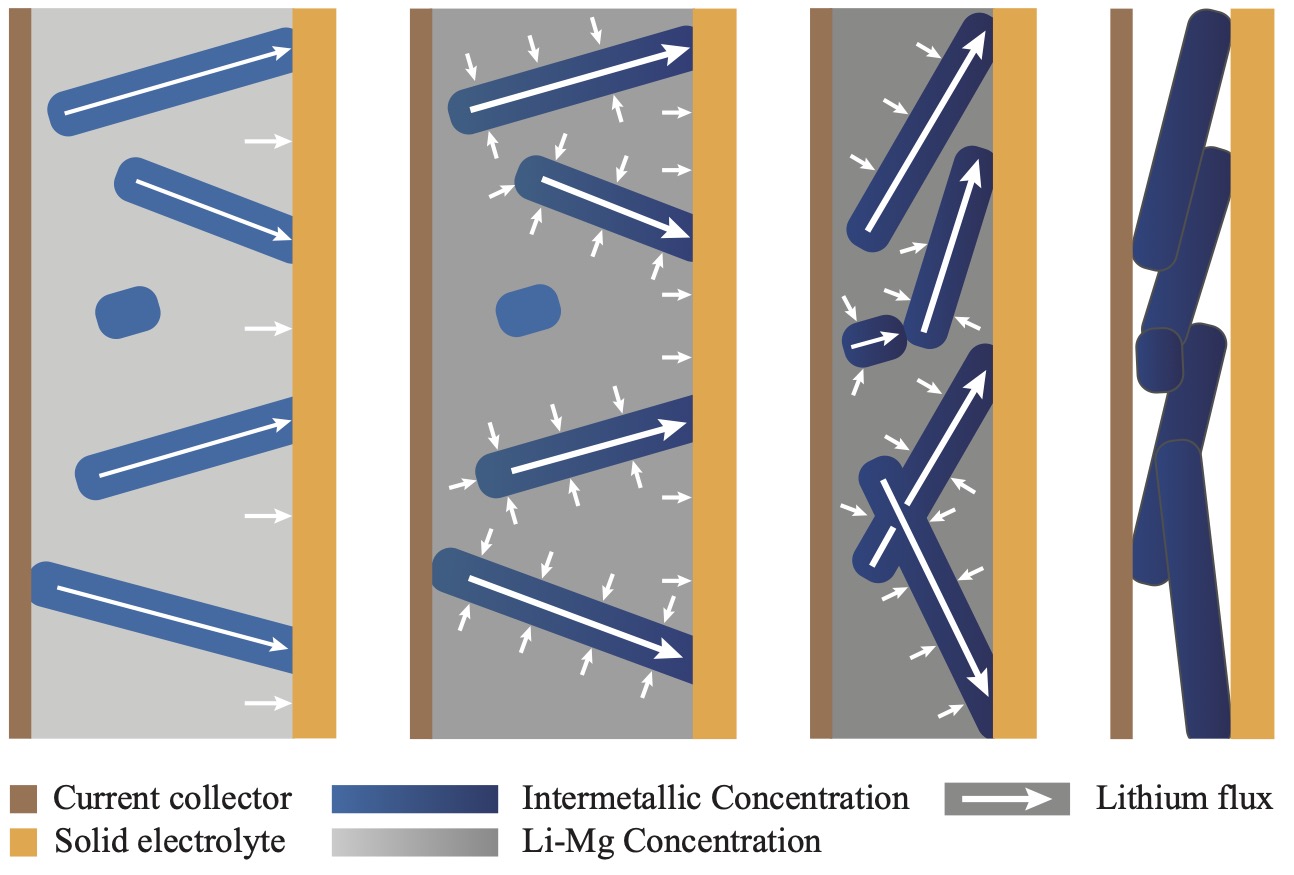
A two-phase lithium alloy system can give exceptionally good performance. The two phases being , comprising lithium–intermetallic and lithium–metal (or similar solid solution).
We demonstrate that the rapid lithium diffusivity in the Li3Bi intermetallic, when combined with a lithium–magnesium matrix, provides continuous fast lithium diffusion pathways that alleviate typical transport limitations during discharge. This work highlights the potential of scalable metallurgical approaches for optimising electrode architecture in solid-state battery systems.
Experimental measurements, supported by computational modelling, quantify the influence of both microstructural features and intermetallic properties on electrochemical performance.
Read the paper
- Impact of metallic interlayers at the lithium-Li6PS5Cl solid electrolyte interface - Joule / 2025
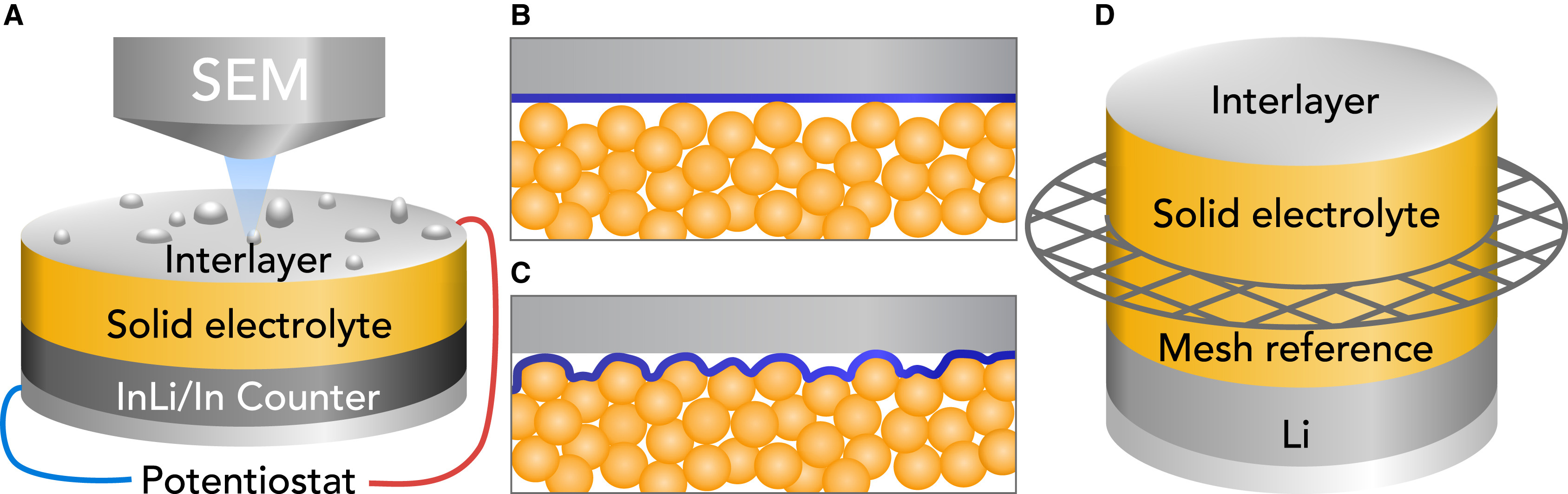
Ideally we want to form an alloy electrode during the first charge of a battery from an alloying metal layer (interlayer). How these thin layers of alloying metal lithiate, and then plate out lithium, impacts battery performance.
We employ operando scanning electron microscopy (SEM) to directly visualize lithiation dynamics within alloy interlayers and the subsequent evolution of lithium plating at the solid-electrolyte interface. These observations reveal how alloy composition and interfacial chemistry govern lithium morphology and SEI development. The results establish design principles for controlled plating and interfacial stabilization, providing new pathways to improve the performance, lifetime, and commercial viability of anode-less SSBs.
Read the paper
- Effect of Microstructure on the Cycling Behavior of Li–In Alloy Anodes for Solid-State Batteries – ACS Energy Letters / 2024
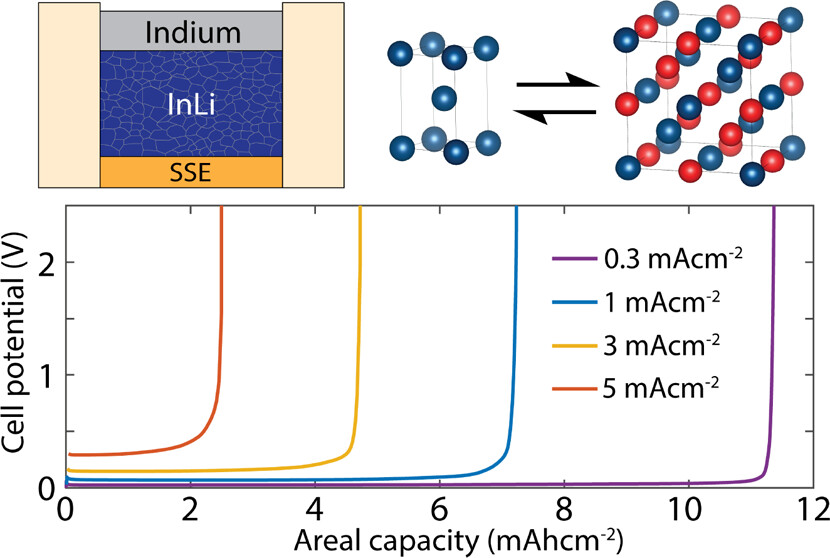
Here we explore a two-phase lithium alloy system of indium and InLi intermetallic. This is a popular solid state counter/reference electrode, which offers low polarization, good accessible capacity, and good cycle life.
Whilst the InLi intermetallic has extremely fast lithium diffusion, indium metal phase is essentially lithium-blocking, so the performance is tied to the microstructure, which evolves with cycling. A simple two-layer microstructure is proposed, based on the fundamental understanding established, which maximizes performance.
Despite the limitations of indium-based alloys in commercial applications, the lessons learned can be extended to other fast-conducting lithium intermetallics.
Read the paper
- The impact of magnesium content on lithium-magnesium alloy electrode performance with argyrodite solid electrolytes – Nature Communications / 2024
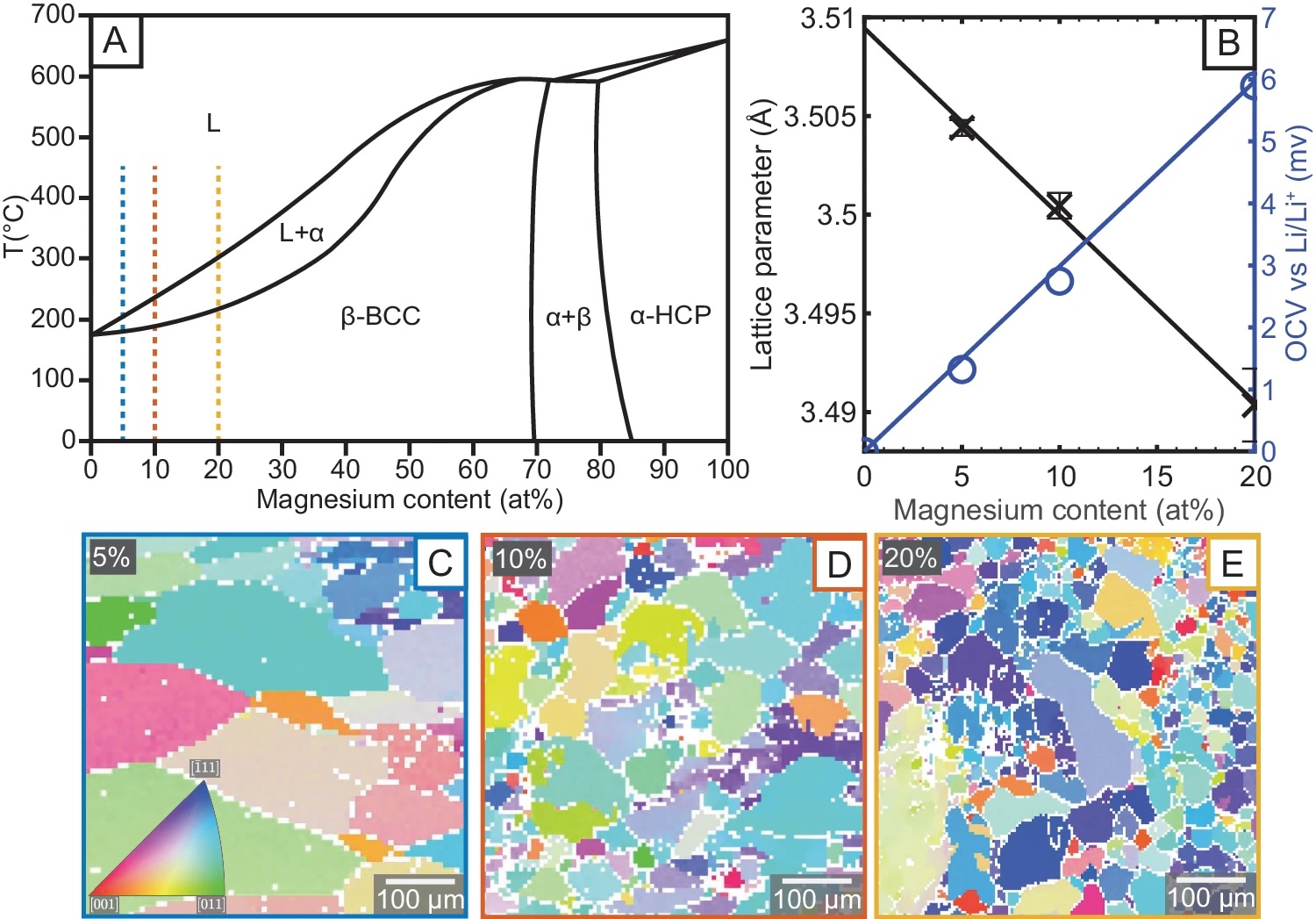
Solid-state lithium-based batteries offer higher energy density than their Li-ion counterparts. Yet they are limited in terms of negative electrode discharge performance and require high stack pressure during operation. The use of lithium-rich magnesium alloys can circumvent some of these issues.
We synthesise and characterise lithium-rich magnesium alloys, quantifying the changes in mechanical properties, transport, and surface chemistry that impact electrochemical performance.
Crucially we observe an improvement in contact retention on discharge, but this must be balanced against a decrease in lithium diffusivity. We demonstrate via electrochemical testing of symmetric cells at 2.5 MPa and 30∘C that 1% magnesium content in the alloy increases the stripping capacity compared to both pure lithium and higher magnesium content alloys by balancing these effects.
Read the paper
Mechanics and microstructure.
- EBSD-coupled indentation: nanoscale mechanics of lithium metal - Materials Today Energy / 2022
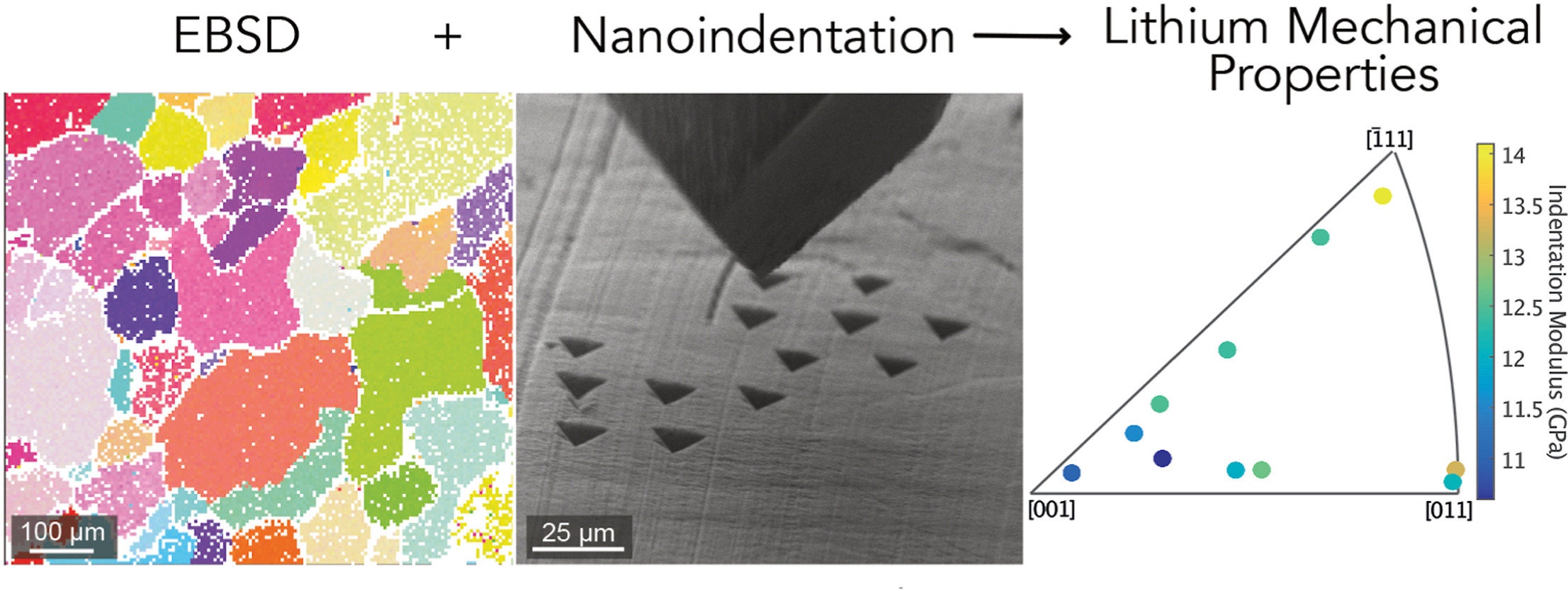 The fracture of ceramic solid electrolytes, driven by the plating of lithium within cracks, has been identified as one of the fundamental issues to successfully develop solid-state batteries. Understanding the mechanics of lithium at the nanoscale is therefore essential.
In this work, the elastic and plastic properties of lithium are measured by nanoindentation within an electron microscope. The crystallography of the lithium metal samples are characterized by electron backscattered diffraction before and after indentation to understand the dependence of the mechanical properties on crystallographic orientation.
Hardness measurements show a clear size effect with hardness in excess of 100 MPa observed for indent depths below 300 nm, which could contribute toward observed lithium filament propagation.
This paper also explored EBSD of lithium metal, which is particularly challenging given its low atomic number and high reactivity - it proposes the use of microtome blades to prepare the sample surface for EBSD.
Read the paper
Other works
A full list of articles I have contributed to can be found on my Scholar page.